
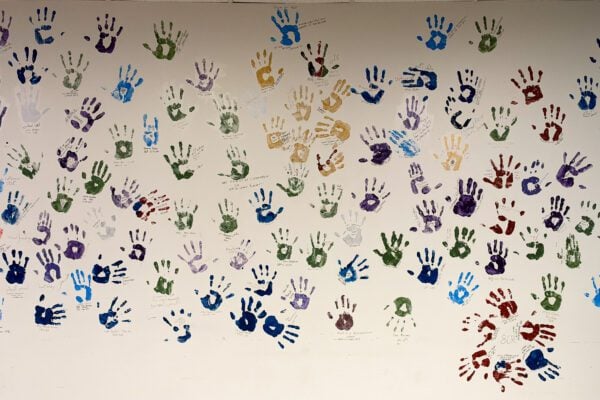
A wall of handprints. A reminder that understanding can be more powerful than force.
These photographs capture one of my favorite walls at Diplomatic Language Services (DLS). Each handprint belongs to an instructor or military participant in the Afghanistan-Pakistan (AFPAK) Hands program—people who were part of an important shift in how the United States military approached the war in Afghanistan.
In 2009, military leadership recognized that winning battles was not enough. A population-centered counterinsurgency strategy required something more: winning trust, understanding cultures, building relationships, and avoiding the creation of new enemies.
The AFPAK Hands program was created to develop military professionals who could engage directly with Afghan and Pakistani communities, officials, and military counterparts—not simply through interpreters, but through their own growing language skills and cultural understanding.
DLS was selected to help make that vision a reality.
In less than 12 weeks, we stood up a comprehensive language and cultural training program, recruiting exceptional native-speaking instructors in Dari, Pashto, and Urdu, developing tailored curricula, and preparing military specialists—many with no prior linguistic training—to communicate across cultural divides.
Our instructors were the heart of that success. They brought far more than language proficiency. They brought lived experience, cultural insight, empathy, and the ability to help military professionals see the world through someone else’s eyes.
The results exceeded expectations. Ultimately, more than 1,000 participants completed the program, with over 92% achieving or exceeding their language proficiency goals. Performance was so strong that the military raised its original proficiency target.
Of course, no language program could determine the outcome of a war as complicated as Afghanistan. But the underlying principle remains as important today as it was then:
The ability to understand another human being can change an encounter from confrontation to connection.
That is what these handprints represent to me. Not just a successful program, but hundreds of people committed to bridging differences and creating understanding where it mattered most.
It is also a reminder of the purpose that has always guided our work at DLS:
We make the world better and safer when we understand each other.
By Jim Bellas, DLS Chairman and former CEO
For more DLS, check out other blogs and visit us on Facebook, LinkedIn, Instagram, or YouTube!